

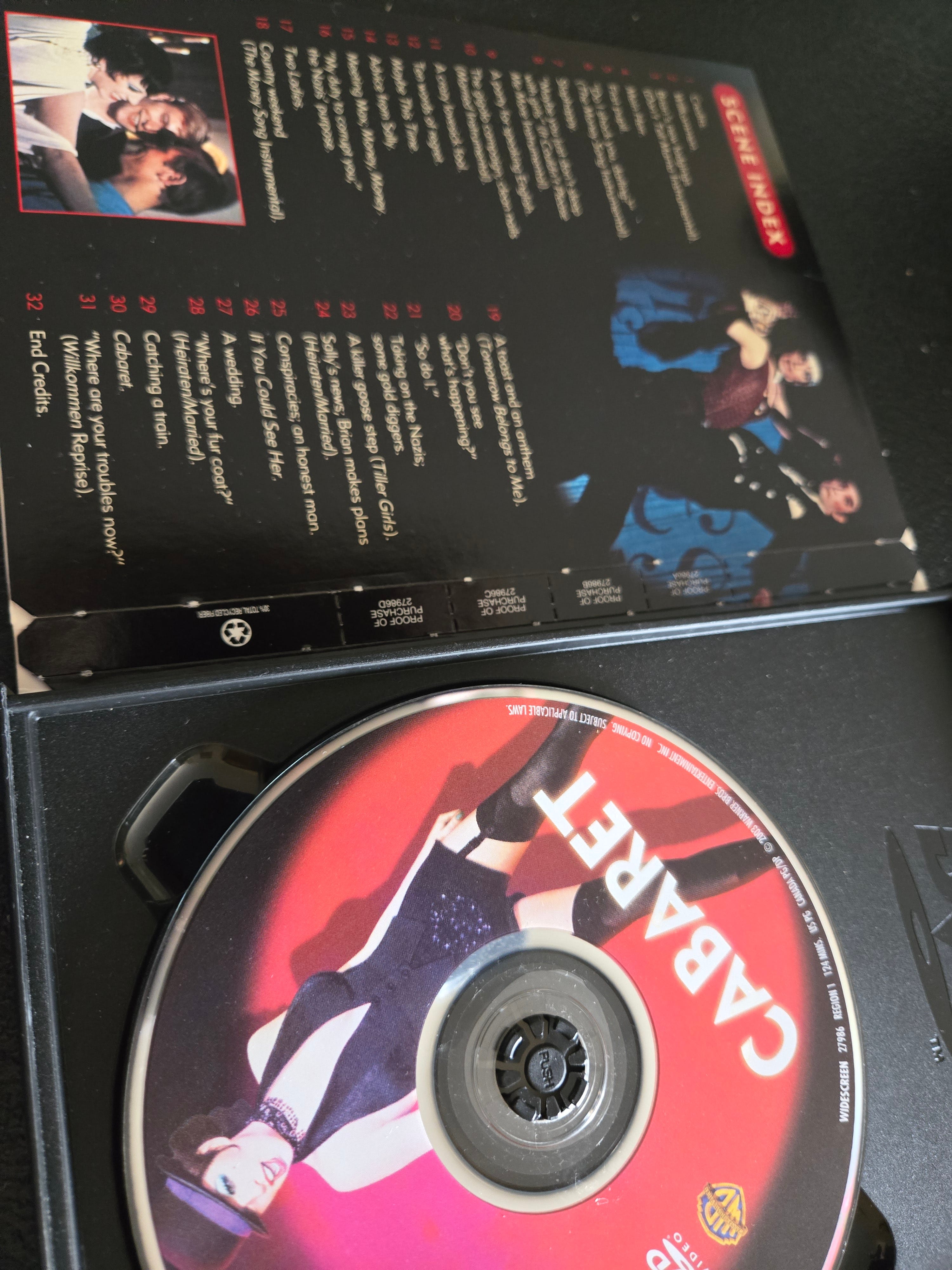
When I was thirteen in 1973, I snuck into a screening of Cabaret. I say snuck in because in Montreal, Quebec, the rating for the film was “14 years and over”. I thought I was getting away with something but the theatre staff couldn’t have cared less. It was a matinee on a sweltering afternoon; I don’t think there were nine people in the theatre, probably there for the air conditioning.
I didn’t realize it at the time, but I was seeing a superior work of art at the exact moment when I was probably ready to notice such things. Whether consciously or not, here is what I took in, and what stayed with me in ensuing multiple viewings of the film.
The Non-musical Musical
Cabaret is a movie musical but I prefer to call it a drama with musical numbers. One of the best choices the filmmakers made was that no numbers occur off the stage of the Kit Kat Club, or away from the beer garden where a Nazi youth incants “Tomorrow Belongs to Me”. No one breaks into song on the street. Passersby do not happen to know the choreography. For those who hate musicals and find such devices cheesy, the film avoids all of them. For those who love musicals, every number is a showstopper (without stopping the plot).
A Downbeat Story
The musical, on stage and on film, broke new ground in that it is not an upbeat narrative with a happy ending. Almost every relationship of consequence splinters. Brian and Sally cannot keep their menage with Max going; Sally has an abortion; Brian and Sally break up. Everything in Cabaret devolves, as the only success in the tale is the rise of the Nazi party in Germany. The difference, compared to happier stories, creates a fascination you can’t turn away from, like a car accident at the side of the road.
Originality and Timing
Bob Fosse and Geoffrey Unsworth directed and edited the movie with endless creativity and unexpected turns. Joel Grey’s sudden, startling appearance as the MC in a mirror at the beginning; the camera following the chorus line in “Wilkommen” in time to the music; perhaps most disturbingly, the brutal beating up of the club owner by the Nazis, edited in contrast to a German folk musical number, the slaps on stage perfectly timed with the hits and stabbings happening steps away in the alley.
A Solid Take on the Story
Cabaret is based on the play (and film) I Am a Camera by John Van Druten, which in turn was based on The Berlin Stories by Christopher Isherwood. Every incarnation has had its own emphasis.
I’ve seen Cabaret on stage a few of times, including a Broadway revival with Joel Grey himself in 1988. Though it was fascinating to see Grey take the MC role further as kind of Nazi puppet, the script made a mistep in deciding that Cliff Bradshaw (Brian Roberts, the Michael York role in the movie) is gay. It took away away the conflict and investment between him and Sally. In the movie, his bisexuality complicates things in a satisfying and unexpected way.
As far as Sally Bowles goes, some stage interpretations have molded her persona to be a no-talent wannabe, drugged out on cocaine and despair as she screeches out the title song at the end. I like Liza Minnelli’s estimation: Sally is talented; she just doesn’t care.
But all this was in comparison years after I first saw the film. I was too naive at the time to understand the sexuality of the Michael York character, nor to get that the screaming folies bergere kick line in red dresses landing in the splits was the Fosse filmic version of an abortion. All of this would fall into place with later viewings. But I still, at the time, felt the chill of the ending, as the camera scanned the nightclub attendees, and almost every other audience member is wearing a swastika.
North Star
I guess everyone has a benchmark- a kind of north star of creative achievement one holds up as some sort of pinnacle. For me, Cabaret was one of the first. And when I see or read a lesser work of art, I sometimes want to recommend the creators watch Cabaret for inspiration, for how far art can go in surprising audiences, getting every element right, and pushing beyond expectations.
What is your north star for creative inspiration?