
How Fiction Works
Discovering James Wood's text is like privately attending a stimulating postdoctoral class on literary theory

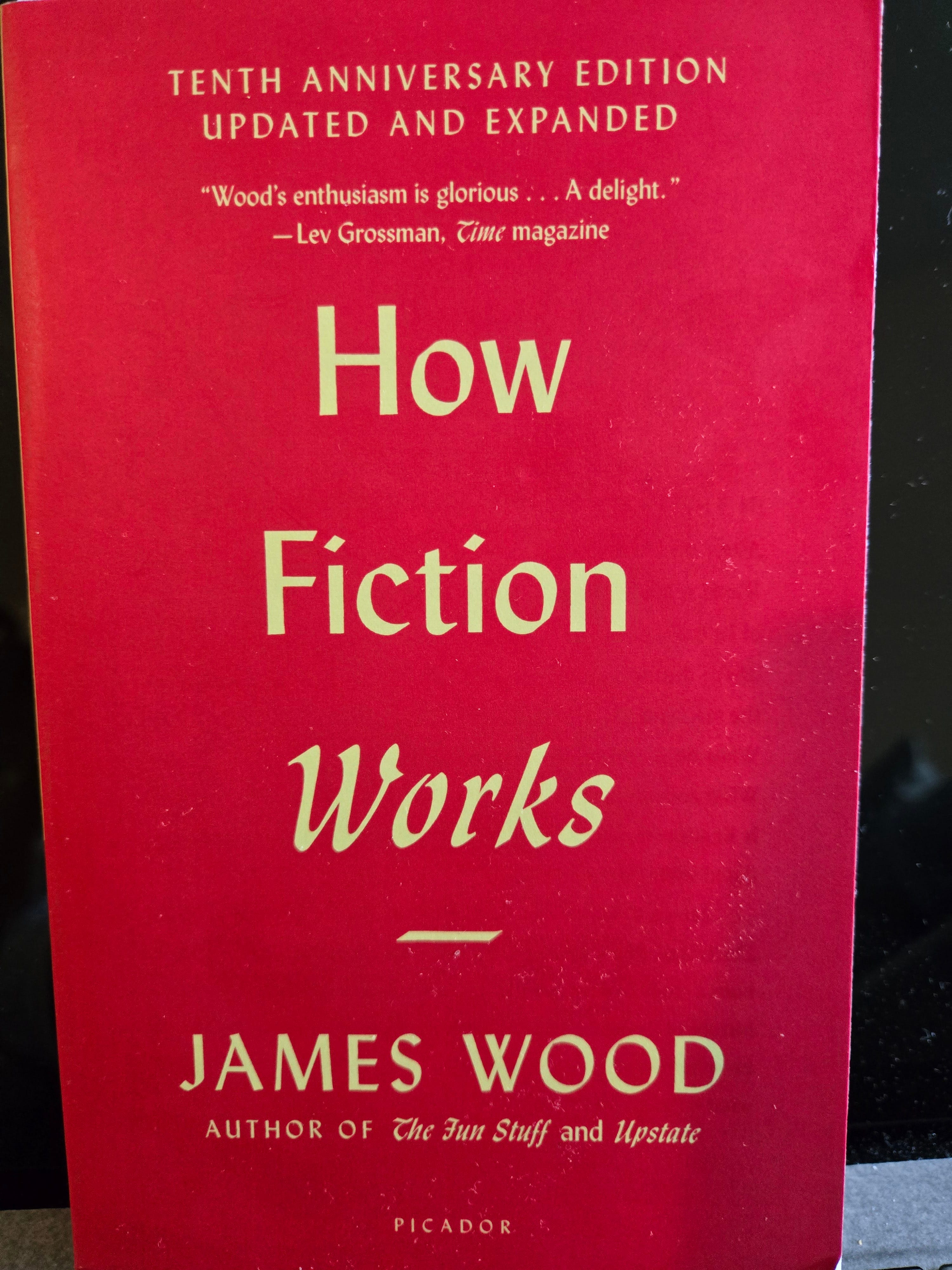
I got introduced to How Fiction Works by James Wood in a writing workshop with Emily Johnson at the Toronto Writer’s Centre. I remembered the chapters and excerpts Emily shared with us, and found them useful.
Perusing the shelves, especially re Writer’s Craft, at BMV, a wonderful second hand bookshop in Toronto, I came across multiple new copies of the red volume and snatched one up at bargain prices ($9 Canadian). Something about having it as a tested talisman made sense to have around.
The overall feeling of the book was like attending a postdoctoral seminar on literary theory.
The books is split into recognizable aspects of fiction, (Narrating; Detail, Character, Form, Language; Dialogue) but also less expected investigations (Flaubert and Modern Narrative; A Brief History of Consciousness; Truth, Convention, Realism). Within each, he explores the topic with his own reading, as well as endless observations about the craft of novel writing by other literary theorists, such as David Shields (Reality Hunger). Others are quoted below.
He references Virginia Woolf: “She understood that fiction also has an ethical form, and that the form of this ethics is constituted both by a writer’s style and by a novel’s substance; this is how the novel justifies itself as a species of moral enquiry, what Ford Madox Ford called ‘a medium of profoundly serious investigation into the human case.’”
Wood almost titled the volume “The Nearest Thing to Life”, form an essay by George Eliot: “Art is the nearest thing to life; it is a mode of amplifying experience and extending our contact with our fellow-men beyond the bounds of our personal lot.” Woods goes on to clarify what he likes about the quote:
“Art isn’t the same as life, but very close to it, and that apparently slight distance (”nearest thing”) is actually a canyon, the large distance of artifice.”
Some examples I new knew well- “The Lady with the Lapdog” by Anton Chekhov (collected in an old paperback Wives and Lovers- stored at our cottage. I reread its heart-rending story every summer.
And books - and films- I was encountering for the first time, including:
The Argonauts by Maggie Nelson
Notebooks of Malte Laurids Brigge by Rilke
The Radetzky March by Joseph Roth
The Year of the Death of Ricardo Reis by Jose Saramago
A Fan’s Notes by Frederick Exley
Through the Olive Trees (film) by Abbas Kiarostami
Other titles I heard of but now they elbowed their way to the front of my consciousness by not only being mentioned, but unpacked to make a particular point about craft: A House for Mr. Biswas by V.S. Naipaul, in an extended musing on dialogue; Elena Ferrante’s My Brilliant Friend, in which a fictionalized Naples presented so specifically that a reader might have assumed an autobiographical origin.
Wood has his own verbiage for well known concepts, such as the unreliable narrator: Referring to Italo Svevo’s Zeno Cosini, “...his self-comprehension, waved confidently before our eyes is as comically perforated as a bullet-holed flag.”
In the opening chapter on narration, Woods expounds at length about “free indirect style”. I recall Emily Johnson sharing with us the segment where Wood unpacks the sentence “Jen watched the orchestra through stupid tears.” The sentence could be much more neutral if the adjective “stupid” is withdrawn. Wood asks” “Whose word is this?” Is it Jen’s ? The narrator’s? The sentence lets the reader toy with an interplay between character and author. And later, this is extended with a term that is probably always underlying such effect: irony. (His example is Nabakov’s wonderful Pnin. Search my Substack Notes for quotes.) He asks directly in the chapter: “Do the words these characters use seem like the words they might use, or do they sound more like the author’s?”
“... the novelist’s job is to become, to impersonate what he describes, even when the subject itself is debased, vulgar, boring.”
A real strength of the new expanded edition is not only the inclusion of modern, international authors not associated with the usual canon of western literature, but up--to-date referencing of modern language. It’s especially true when he elaborates on how a novelist works with his own language, “style, perceptual equipment...”, the character’s presumed language, and “the language of the world.” This “tripleness” is important, especially since for the contemporary writer, such language includes “the blogosphere, and text messaging”. The edition came out in 2018, just before the pervasive influx of AI, but one can include it as we read Wood’s informed analysis.
“...narrative can and often does give us a vivid sense of a character without giving us a vivid sense of an individual. We don’t know this particular man; but we know his particular behavior at this moment.”
“My own taste tends toward the sketchier fictional personage, whose lacunae and omissions tease us, provoke us to wade in their deep shallows.”
“Is there a way in which all of us are fictional characters, parented by life and written by ourselves?”
“Yet the novel suggests that perhaps there is something culpable about being content with the spectacle of the world when the world’s spectacle is horrifying.” Does that sentence not speak to the present moment? One of literature’s enduring villains is Muriel Spark’s Jean Brodie (The Prime of Miss Jean Brodie). I know the novel and film well well, so this example spoke powerfully to me. Wood writes that in some ways, we learn little about her. ”Around her very thinness as a character we tend to construct a thicker interpretative jacket.”
“Art insists on concentration by virtue of having form. Life, as I suggested, strikes us as essentially formless; and technology, though full of cute, discrete objects, is essentially formless too. It’s protean. It’s about the process of endlessly becoming, proud of its built-in obsolescence...When video games are extolled for being like novels- for their “fiction-making qualities’- the emphasis is generally on the multiplicity of options and choices, not on the determinism of form.”
He finds a way to sum up a sentence probably needs no summing up. From Woolf’s The Waves,- ‘The day waves yellow with all its crops.’ Wood refers to the image as “a yellow semaphore.”
Brigit Lowe is quoted as saying that “the primary objective [of story-telling] is to produce an imaginative experience,” more so than teaching a lesson.
And in exploring or expanding or expounding on life, Virginia Woolf observes, “Why should a real chair be better than an imaginary elephant?” It makes me think of the use of autobiographical elements vs. digging into one’s store of inventiveness for the creation of art.
Don’t forget to mine the expansive list of books and authors at the end, listed in order of publication date.
Wood begins the book with an epigram from Henry James: “There is only one recipe- to care a great deal for the cookery.” Wood demonstrates, on page after page, his own care, and others’, for that exact recipe.