


Some books’ length intimidate. Just about everything by Charles Dickens falls into that category. There are so many other stories one could peruse. Why choose this hoary classic? Because I’ve never read it.
Why Dickens?
I assumed Dickens was going to be a bit of a slog. Yet Dicken’s wordiness didn’t stop me, once upon a time, from diving into Bleak House. It filled up the summer I devoted to it, and filled me up. What a premise. A lawsuit that never ends, and goes on for generations. I won’t ruin the ending for you, in case you commit to it like I did, or at least you could enjoy the superior TV adaptation with Gillian Anderson. (I ended up referencing the story in a play of mine.)
Adjust Your Expectations
Tomes like that one, and David Copperfield, also intimidate because of the language. As a reader here on Substack reminded me, such endeavours can be tackled by adjusting one’s expectations. Expect the language to be different, unfamiliar, steeped in its own era. That’s half the appeal. The language itself slows me down, and as a modern reader, I’m grateful for the experience. You can bet I am reading a paperback, bought for $3 at a used bookstore, so I don’t have to worry about library deadlines, and I can mark it up if I choose. I’m definitely not scanning it online, or listening to the audio recording.
I already roughly knew the plot of Copperfield. Not just its famous opening line (“Whether I shall turn out to be the hero of my own life, or whether that station will be held by anybody else, these pages must show.”), but all that ensues. I became familiar with it first as a kid with a Classics Illustrated comic book.
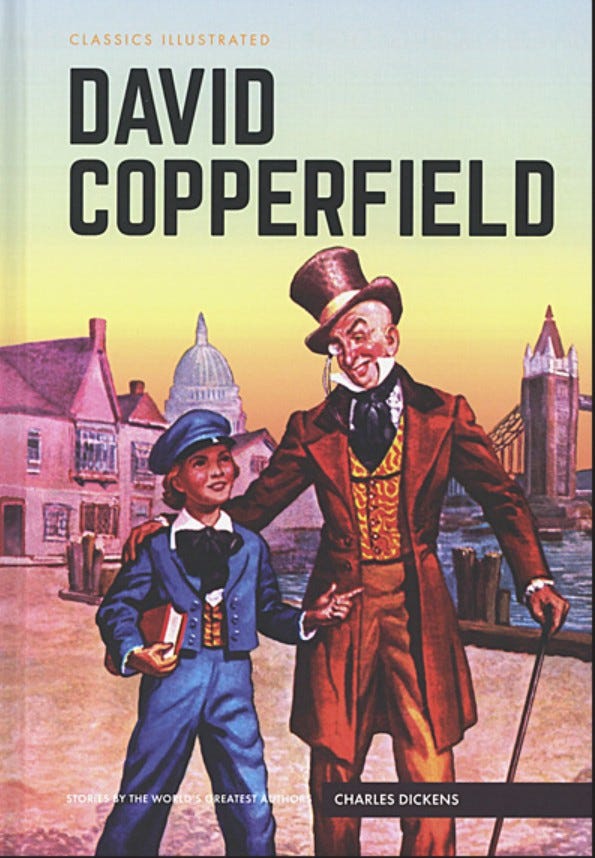
My brother and I used to hoard them, until I foolishly donated the remainder to the summer camp I worked at. When I rediscovered the comics years later in a second hand bookstore, David Copperfield was one of the ones I picked up. Yes, because of the story, but also out of a nostalgia for my childhood, immersed in the worlds those early versions of graphic novels presented.
Film Versions Help
The story also cemented in my brain after the seeing the latest film version with Dev Patel (2019). The movie has its detractors for the very thing that others love about it: the cross-cultural casting of top tier actors in key roles. Whether you liked it or not, the film stayed quite true to the story of the book itself (or at least the comic I remember). I have yet to sit through the 1935 black and white version with W.C. Fields as Micawber. I’ll wait until I’ve read more of the original text.
Why devote time to such a long read? Because of descriptions like this.
And this:
“…if the land had been a little more separated from the sea, and the town and the tide had not been quite so much mixed up, like toast and water, it would have been nicer.”
There will be plenty more.
Don’t forget the character names: the Murdstones; Uriah Heep (a 70’s rock band used it); Barkis (“‘if Barkis is willin’’”); Steerforth; Betsy Trotwood. The monikers create connections in our minds even as we first meet them.
I’m on page 93 of the 950 page volume. I’ll probably interrupt the read with shorter, more current books along the way, but I plan on completing David’s journey.
Enjoy. I reread David Copperfield last year after finishing Barbara kingsolver's modern take on the tale, demon copperhead. Beyond the twisting plot of misadventures, Kingsolver has borrowed much of Dickens's style: short chapters, sudden reversals, coincidencal meetings, a colourful cast of characters with names like Stoner, Fast Forward, swap-out.
That being said, the modern take felt bleaker to me. Perhaps it is The setting is Appalachia at the height of the opioid crisis and the ending feels less hopeful and more tentative. Dickens characters may have lived materially harder lives, but those lives seem to me to have been embed with a greater sense of purpose and hope.
Thank you for reminding me of this book. Inspired me to read again.